 Choosing home education gives families greater control over how their children learn. But this flexibility alone is not enough. Parents also need confidence that their children are following a credible curriculum and making meaningful progress.
Thus, the challenge for home education providers is to make academic structure and quality learning accessible without removing the parental involvement and choice that make home education attractive in the first place.
This is where the conversation about home education needs to shift. It should not be a debate about whether learning at home is better or worse than conventional schooling. It should be about what families need to make their chosen approach work, and how home education providers can support them in meeting these needs.
A curriculum needs to do more than deliver content
For parents, taking responsibility for home education can mean navigating curriculum requirements, finding suitable resources and tutors, and working out how to assess their children’s progress. However, a collection of lessons and activities may provide content without ensuring the standards required for progression through the grades. It also does not necessarily give parents the framework they need to understand what their children should be learning, how knowledge builds over time, or where additional support may be needed.
Assessment is particularly important. Completing a lesson does not automatically mean a learner has understood it. Parents need meaningful ways to evaluate understanding and identify gaps. Assessment should therefore be an integral part of a home education programme, rather than an afterthought.
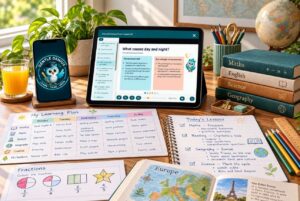
The approach should therefore combine a CAPS-aligned curriculum with structured lessons, learner-friendly explanations, activities, and learning resources, alongside an integrated assessment model to help parents evaluate progress and make more informed decisions about their children’s learning. This all-round approach gives families an academic framework to work with, without requiring parents to develop the curriculum and its supporting resources themselves.
 Accessibility must be practical, not just theoretical
The flexibility of home education is valuable because families have different circumstances. Learning may need to fit around work, travel, sporting commitments, or other family responsibilities. But, for flexibility to be sustainable, the resources families use must be accessible and practical in their everyday lives.
Digital delivery removes geographical constraints, allowing families to access a curriculum without living near a particular school or provider. However, homeschooling models often assume that children have their own laptops or tablets, and that their connectivity is high-speed broadband.
The Gentle Genius premise is to ensure access via a mobile-first, low-bandwidth design. This delivery model is part of our educational solution, not simply a technical consideration.
The same principle applies to affordability: a credible option must be financially realistic for the families it intends to serve.
 Transparency is part of educational choice
Parents should be able to make decisions based on a clear understanding of what a programme includes and what they may need to provide themselves.
Transparency enables parents to assess an option against their needs and budget, rather than relying on a headline price alone. It also reflects a broader responsibility for homeschooling providers: to help families understand what they are choosing, as well as what their choice involves.
Ultimately, South African families need credible homeschooling options that recognise the diversity of their circumstances. Home education does not need to compete with conventional schooling to justify its place, and it may not be the right choice for everyone. But, for families who choose it, the quality of the academic framework, the usefulness of the assessments, and the accessibility of the resources make a meaningful difference.
About Gentle Genius
-
- For 2027, the Gentle Genius subscription is R999 per month for 11 months, or R10,989 per learner for the year. This provides learners with access to our structured, CAPS-aligned curriculum and learning resources.
-
- Our focus is on Grades 4–7. We believe that younger learners can benefit more from a traditional school environment with educator and peer interaction. From Grade 4, learners are more able to work independently.
-
- Our aim is to enable parents to take ownership of their children’s education with greater confidence, supported by the structure and resources to make home education work.
-
- We have developed a comprehensive guide to potential additional costs and home education requirements, including relevant legislated registration.
-
- You are welcome to sign up for a free trial today by visiting gentlegenius.co.za. There is no need to book a demonstration first. Simply register, explore the programme, and see how Gentle Genius could fit into your homeschooling environment, cottage school, or learning hub.
If you would prefer a personal introduction, call us on 087 265 1844.